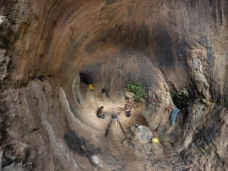
Son Doong is a world of its own beneath the Truong Son Range — a place where ancient rock, subterranean rivers, skylights, primeval forest, colossal stalactites, and dark zones specially adapted for life coexist within a geological body that is almost without equal. For that reason, to call Son Doong “the world’s largest cave” is correct, yet still too limited. More precisely, it is an extraordinary wonder: extraordinary in scale, in geological history, in geomorphological structure, in microclimate, in ecosystem, and even in its power to compel us to rethink what lies beneath the earth.
Information about Son Doong Cave
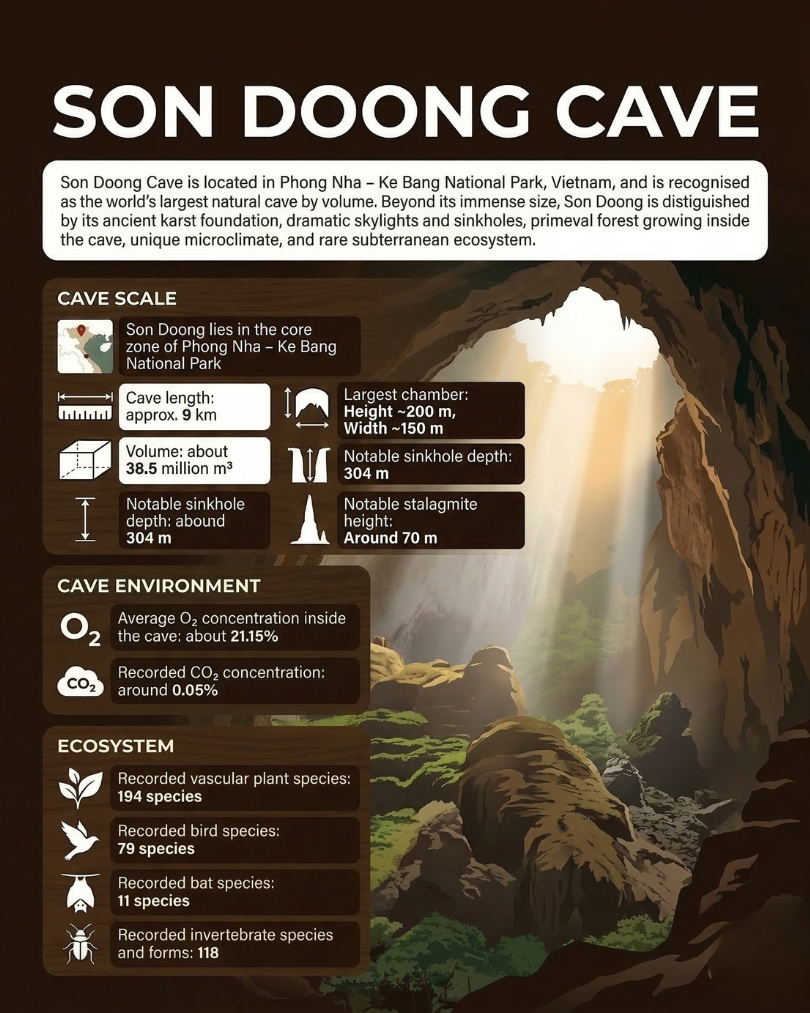
Son Doong Cave lies within Phong Nha – Ke Bang National Park, Vietnam, and is recognised as the world’s largest natural cave by volume. Beyond its immense size, Son Doong stands out for its ancient karst foundation, its system of skylights and sinkholes, its primeval forest growing בתוך the cave, its distinct microclimate, and its rare subterranean ecosystem. The cave is approximately 9 km long, with a volume of around 38.5 million m³. Its largest chamber is about 200 metres high and 150 metres wide. A notable sinkhole reaches a depth of around 304 metres. Its giant stalagmites rise to around 70 metres. The average oxygen concentration within the cave is about 21.15%, while recorded CO₂ is around 0.05%. Biodiversity studies within the cave and its adjacent areas have recorded 194 species of vascular plants, 79 bird species, 11 bat species, and 118 species and forms of invertebrates.
Information about Son Doong Cave
The geological foundation of Son Doong
To understand Son Doong, one must first step far back in time. Son Doong lies within the Phong Nha – Ke Bang karst massif, which UNESCO has identified as having evolved over roughly 400 million years and as one of the oldest large-scale karst regions in Asia. In the Son Doong area and its surroundings, the attached research materials show geological formations ranging from around 66 million to 419 million years old, revealing an exceptionally deep geological timescale. This means that Son Doong is not the product of a single geological event, but the result of many long chapters in Earth’s history: ancient seas, tectonic movements, uplift and subsidence, limestone dissolution, cave roof collapse, and the remaking of underground landscapes over millions of years.
It is precisely this that makes Son Doong so profoundly different. Many natural wonders overwhelm because of their outward appearance. Son Doong overwhelms from its very foundations. It stands upon a karst base shaped by a depth of geological time that very few places in Asia can match. While many famous caves are spectacular products of landform development, Son Doong is also a living geological record, where every rock section, every sediment layer, and every trace of dissolution reads like a page from the planet’s archive.
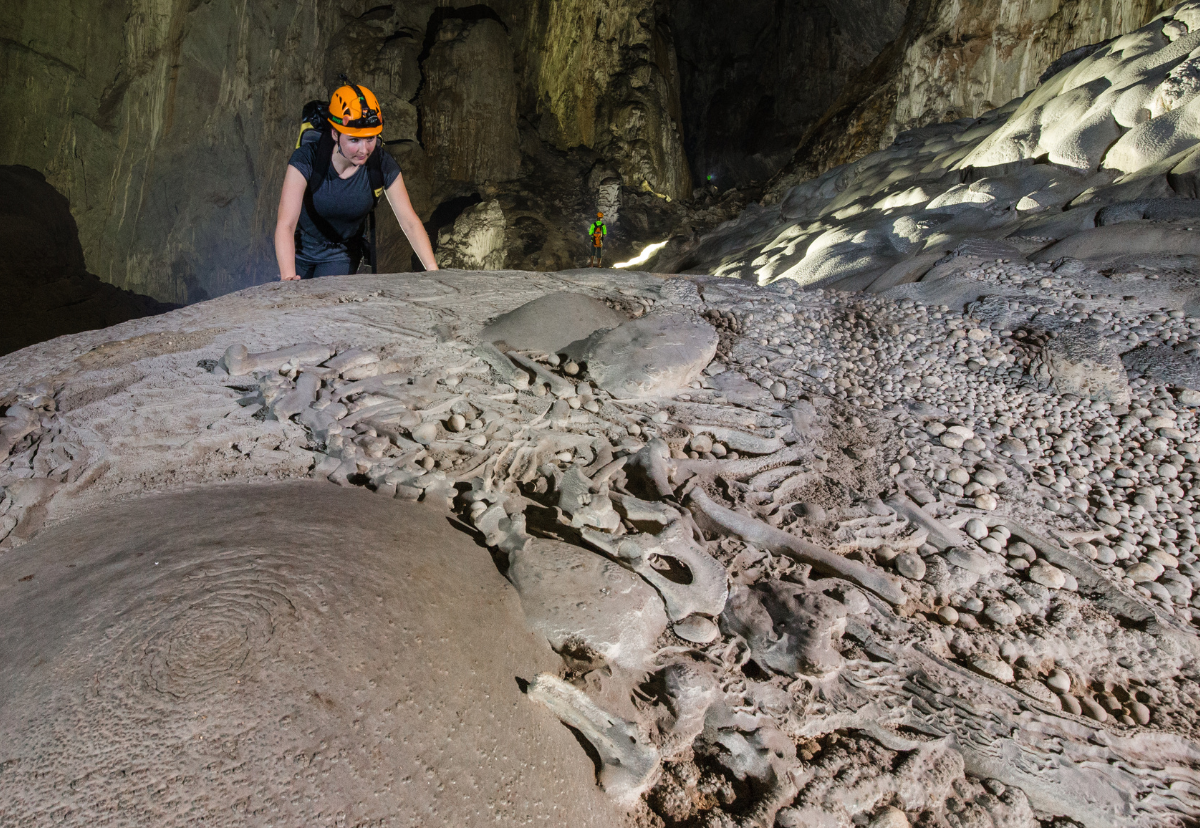 Ungulate fossils in Son Doong Cave
The geomorphology of Son Doong
What immediately sets Son Doong apart from all ordinary comparisons is its size. Research materials indicate that the cave is about 9 km long, with a measured volume of approximately 38.5 million cubic metres. Its largest chamber rises to around 200 metres in height and 150 metres in width. Guinness World Records recognises it as the cave with the world’s largest single passage. These figures may sound like the language of engineers or geologists, but in truth they speak in terms that are very easy to grasp: Son Doong no longer feels like “a cave” in the ordinary sense; it is a space so vast that it alters one’s sense of scale.
The significance of these numbers only truly becomes apparent when set in comparison. Before Son Doong was fully surveyed, Deer Cave in Gunung Mulu, Malaysia, had long stood as the emblem of colossal cave chambers. Yet the data in the attached materials show that Son Doong surpassed Deer Cave to claim the record as the world’s largest cave. If Deer Cave was a symbol of vastness, Son Doong represents a leap beyond — a place where the standard of cave “size” had to be rewritten. The difference is not merely a matter of a few metres in height or width. It is a difference of conception: from imagining a large rock chamber to accepting that beneath the earth there can exist a world large enough to contain forests, rivers, climate, and entire ecological gradients of its own.
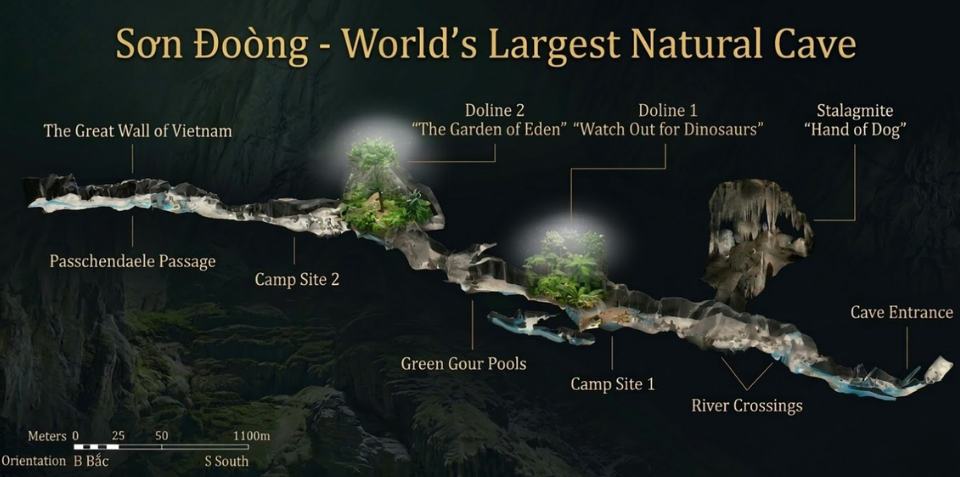 Model of Son Doong Cave
Dolines and forest within the cave
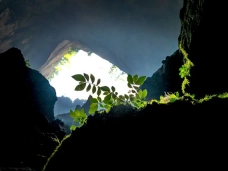
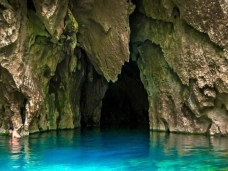
If size were all it possessed, Son Doong would already be impressive. Yet what makes it almost irreplaceable lies in its internal geomorphological structure. The cave contains two vast sinkholes — two “skylights” formed by the collapse of the cave roof, allowing light to penetrate the underground world. It is here that one of the rarest phenomena in the cave world has taken place: trees have grown and formed patches of primeval tropical forest within the cave itself, most famously the “Garden of Eden”.
This lifts Son Doong far beyond the conventional description of a beautiful cave. Many caves around the world possess magnificent stalactites, underground rivers, or large chambers. Yet very few combine all three of the following at once: an immense chamber, natural skylights, and forest flourishing deep within the cave. In Son Doong, a sinkhole is not merely a geological accident; it is a gateway through which light enters and geomorphology is transformed into habitat. From that point on, the underground is no longer simply rock and darkness. It becomes a world of light and shadow, humidity and dryness, enclosure and openness, stillness and movement, with different biological communities occupying each stage of the light gradient.
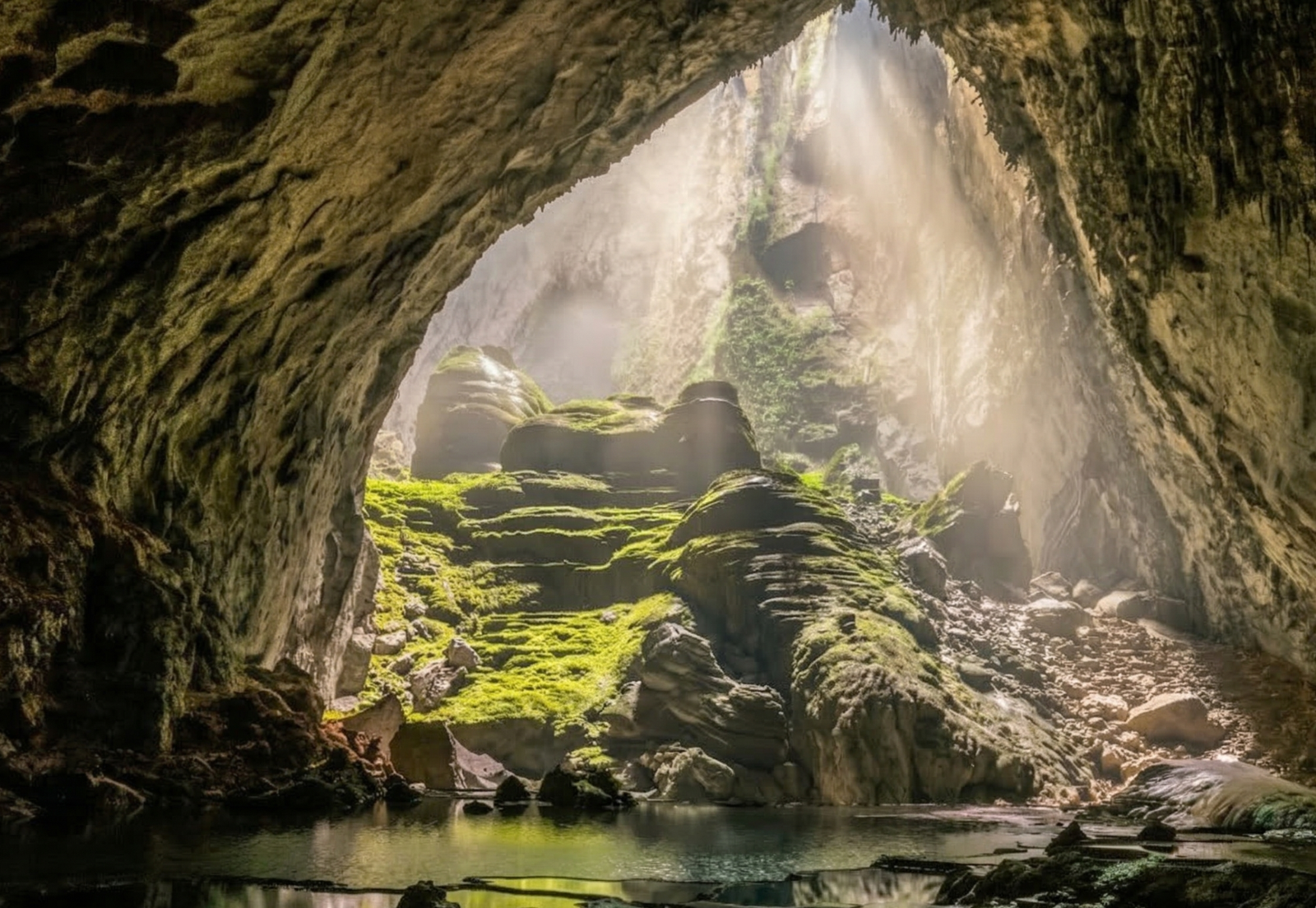 Watch out for Dinasour
Stalactites and stalagmites
Son Doong possesses cave formations among the most spectacular ever recorded. Research materials document the “Hand of Dog” stalagmite cluster at around 70 metres high, comparable to the famous giant stalagmites of Zhijin Cave in China. The same materials note that the massive flowstone formation known as the “Great Wall of Viet Nam” is regarded as one of the largest of its kind in the world. Here, stalagmites are no longer simply decorative features. They have become landforms in their own right — mineral architectures immense enough to define the entire sense of height, depth, and weight of the space around them.
It is this natural enlargement that sets Son Doong apart from most other famous caves. Elsewhere, beauty often lies in the delicacy of cave formations. In Son Doong, beauty is both intricate and overwhelming. Its grandeur lies not in fine detail alone, but in the way nature has pushed every form to such a scale that visitors feel as though they are standing inside an ancient cathedral built by water and stone over millions of years.
The microclimate of Son Doong
Another value that is rarely fully appreciated is its microclimate. Son Doong is so vast that the air, humidity, temperature, and water flow within it together create a rhythm of their own. Survey data from January 2023 in the attached materials show that air quality throughout the Son Doong system is generally stable. Water inside the cave has an average temperature of around 19.62°C, an average pH of 8.08, and average dissolved oxygen of 8.98 mg/l, indicating a cool, stable, mineral-rich environment shaped by long interaction with limestone. Some water samples also show high calcium concentrations, around 92–120 mg/l, clearly reflecting the karst geochemical signature.
Seen in comparison, this is a particularly striking point. People often imagine caves as airless, dark, oppressive, and motionless. Son Doong is the opposite. It has enough air circulation to sustain a microclimate of its own; skylights regulate light and moisture; pools, flowing water, damp rock surfaces, light mist, and immense open spaces combine to create the sensation of moving through two different kinds of weather in a single day. For that reason, Son Doong is not merely “a very large cave”, but an underground space functioning as an independent environmental system on a remarkably rare scale.
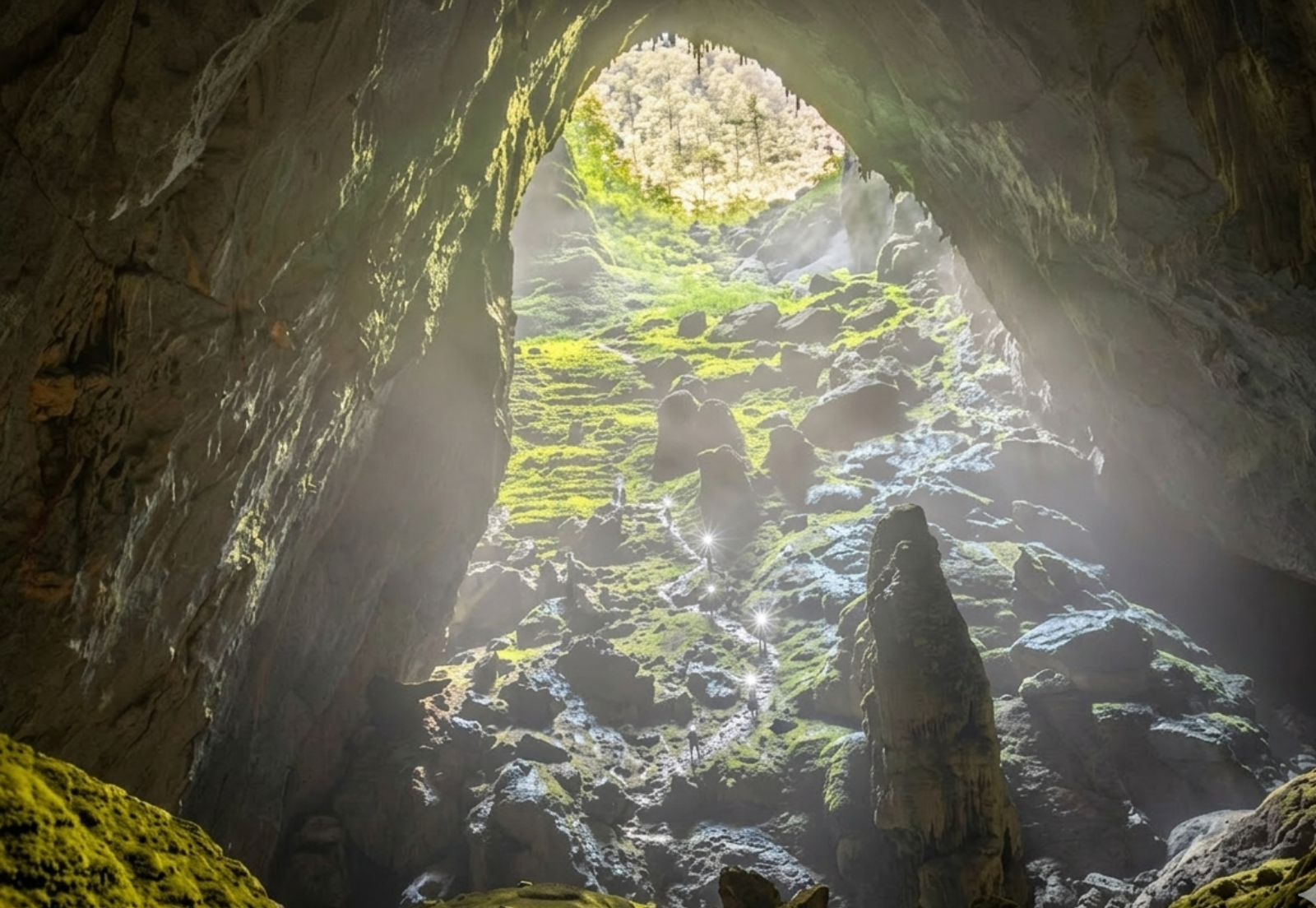 The Garden of Adam with its living communities
Environment and ecosystem
Another outstanding value of Son Doong lies in the fact that its immensity is far from empty. Research in the Son Doong area and surrounding region has recorded 194 species of vascular plants, of which 174 are additional records for the flora of Phong Nha – Ke Bang National Park. The same materials also record 11 bat species, 79 bird species, 118 species and forms of invertebrates, and several groups that may represent species new to science. In the illuminated zones near the sinkholes, trees, mosses, lichens, and ferns flourish. In the transitional zones, shade-tolerant species appear. Deeper inside lies the realm of organisms fully adapted to darkness, where eyes may be reduced while tactile organs, antennae, or sensitivity to vibration become more developed.
This is where Son Doong transcends the category of scenic attraction. Many large caves are objects of tourism or exploration. Son Doong is, at the same time, a natural laboratory for evolutionary biology, cave ecology, and conservation science. It shows that the underground does not merely preserve stone; it also preserves the highly refined pathways through which life adapts. Because it contains fully lit, semi-lit, and completely dark zones within one immense system, Son Doong forms a miniature yet exceptionally complete ecological spectrum. Very few caves are both so large in scale and so rich in ecological transition.
The extraordinary value of Son Doong
If Deer Cave once represented the image of the colossal cave, Son Doong is the place where the world had to revise its scale of magnitude. If many karst heritage sites are celebrated for their beautiful forms, Son Doong stands upon one of Asia’s oldest karst foundations. If most caves are associated with darkness, Son Doong possesses skylights, forest, a localised climate, and vivid ecological gradients. If many caves are renowned for beauty, Son Doong is remarkable for the completeness of the relationship between geology, geomorphology, environment, and biodiversity. In other words, other places may excel in one respect. Son Doong excels in many at once — and it is precisely this convergence that makes it extraordinary.
A wonder on this scale is by no means invulnerable. Climate change is driving extreme floods, causing erosion, sedimentation, altered water flow, and land-use pressures in the buffer zone, all of which are placing strain on the wider Phong Nha – Ke Bang heritage system. Surveys carried out after the floods of October 2020 showed that around 25% of the park area was inundated; many places suffered landslides and sediment deposition, while some cave formations in several systems were broken or damaged. This is a clear reminder of an important truth: Son Doong’s extraordinariness lies not only in its rare scale, but also in the delicacy of the natural balance that allows such a world to exist. A place that took millions of years to form can be harmed in a very short time if conservation discipline is not rigorously maintained.
Son Doong is more than a natural wonder. It is proof that the underground, too, can possess the scale of a universe. Here one encounters the age of stone, the breathing rhythm of climate, the movement of water, the upward reach of forest, the survival strategies of creatures adapted to darkness, and a silence so immense that human voices instinctively grow softer. It is because of this convergence of outstanding geological, geomorphological, microclimatic, environmental, scenic, and biological values that Son Doong deserves to be called an extraordinary wonder beneath the earth — not through emotional praise, but through evidence strong enough to stand against the most serious comparison.
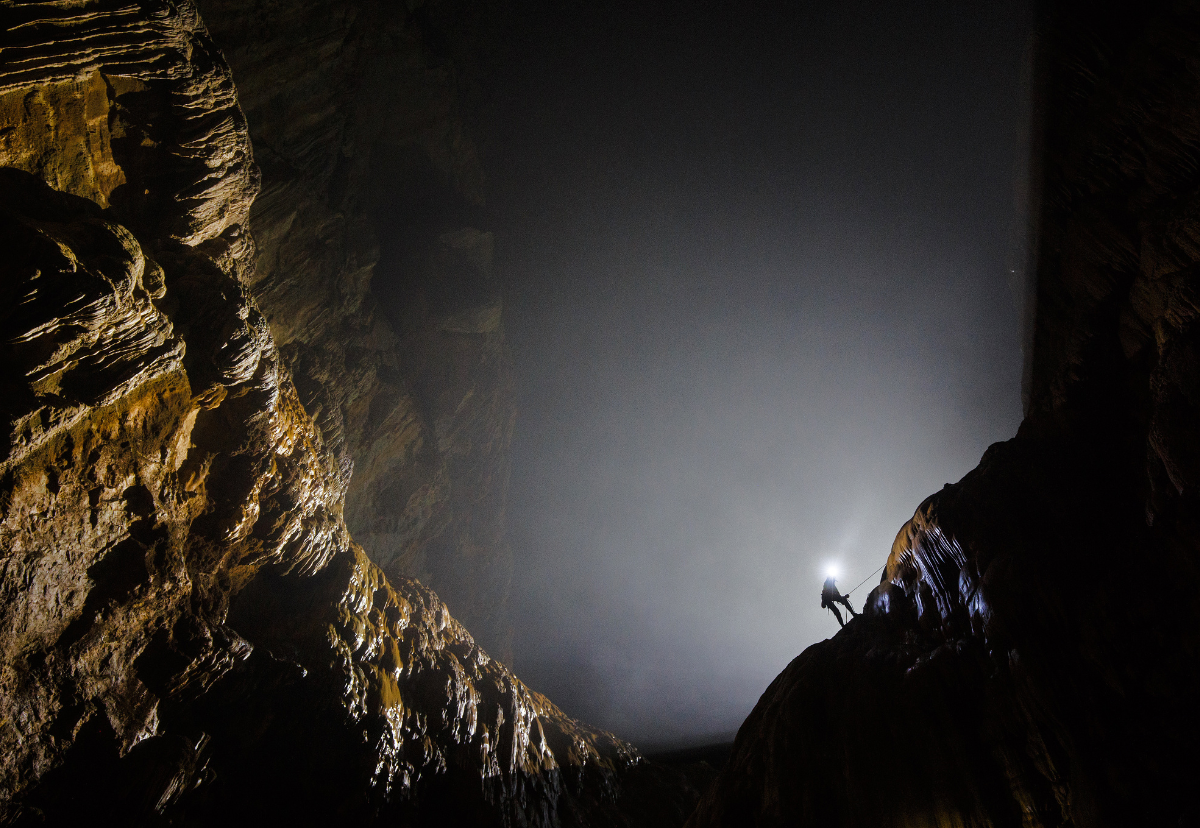 Conquering the Great Wall of Viet Nam inside Son Doong Cave
Phong Nha – Ke Bang, where adventure travel comes together
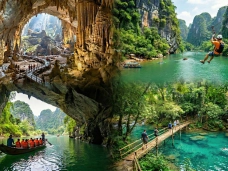
If Son Doong is the pinnacle of the underground world, then Phong Nha – Ke Bang also opens up many other distinctive adventure journeys for those who love forests, caves, and the desire to venture deeper into this magnificent karst landscape. From one-day tours involving trekking, cave swimming, kayaking, or light camping, to multi-day expeditions with abseiling, underground river crossings, sinkhole traverses, and overnight stays inside caves, each journey presents its own degree of challenge.
Moderate
The moderate category is suitable for travellers with reasonable fitness who enjoy exploration but are not yet ready for the most demanding routes. This group includes Elephant Cave & Ma Da Valley Jungle Trek 1D, which Jungle Boss describes as suitable even for those with limited trekking experience; Tra Ang Excursion 1D, which involves walking and cave swimming at a moderate level; Phong Nha Cave 4.5 km – Xuyen Son Ho Exploration; Paradise Cave 4 km Expedition; Ma Da Valley Jungle Camping 2D1N; and Hang En Adventure, often seen as a graceful transition from adventure travel into true expedition-style exploration.
Fairly demanding
The fairly demanding category is suited to those already accustomed to outdoor activity, with good stamina and a willingness to swim through caves, climb slopes, and cross streams for extended periods. In this group are Hang Pygmy Exploration 2D1N, Paradise Cave 7 km Expedition, Hang Va – Nuoc Nut Cave, with mountain trekking, stream crossings, and forest camping; Hung Thoong Exploration 3D2N, where Jungle Boss introduces experiences such as ziplining over a sinkhole, abseiling, and cave swimming; together with Hang Tien – Tu Lan Discovery and Tu Lan Experience. Materials from both Oxalis and Jungle Boss show that Hung Thoong and Tu Lan have already moved into the demanding category, more strenuous than standard exploration routes.
Difficult
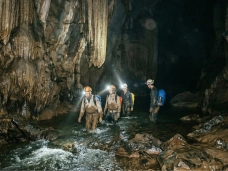
This category is reserved for travellers with very strong physical fitness, a clear expedition mindset, and a readiness to face consecutive days of trekking, climbing, swimming, abseiling, cave overnights, or deep-forest camping. The most notable routes are Tiger Cave Series Adventure 3D2N, Kong Collapse Top Adventure 5D4N, which includes abseiling into a sinkhole of around 100 metres and requires skills training before departure; and, at the highest level, the Son Doong Expedition 4D3N, which Oxalis describes as the most difficult route in its portfolio and one that demands very high physical fitness.
Expeditions waiting for you
SPECIAL PHONG NHA KE BANG TOURS
Unique cave adventures, night exploration, and unforgettable trekking experiences
Phong Nha Cave Night Tour
Highlight: Discover the magical atmosphere of Phong Nha Cave at night with a quiet, mysterious, and truly different experience.
Book Tour
Conquering 4,500m Phong Nha Cave
Highlight: Go deeper into the cave, enjoy kayaking, and experience a more adventurous side of Phong Nha’s hidden beauty.
Book Tour
Paradise Cave 4,000m Adventure
Highlight: Explore deeper beyond the regular route and get closer to the breathtaking formations inside Paradise Cave.
Book Tour
Discover the 7km Paradise Cave
Highlight: A deeper and more challenging adventure for travellers who want to experience the grandeur of Paradise Cave in full scale.
Book Tour
Survival Valley – Thuy Cung Cave Trekking
Highlight: Trek through pristine forest, cross streams, and discover one of Phong Nha’s most thrilling natural adventure routes.
Book Tour
Phong Viet