


Kling – Ruc Ca Roong – A Cu Cave Complex: Water, Stone and Forest in Phong Nha – Ke Bang
18-04-2026 16:46
Main contents
Amid forests still thick with shade, where the route is not a familiar tourist trail but a passage across streams, damp moss and sharp limestone, the Kling – Ruc Ca Roong – A Cu complex appears like another world altogether. It is not loud. It is not showy. It quietly reveals layer after layer of stone, water and time.
Many places are beautiful because they are easy to reach. This one is beautiful because it has kept just enough distance from people.
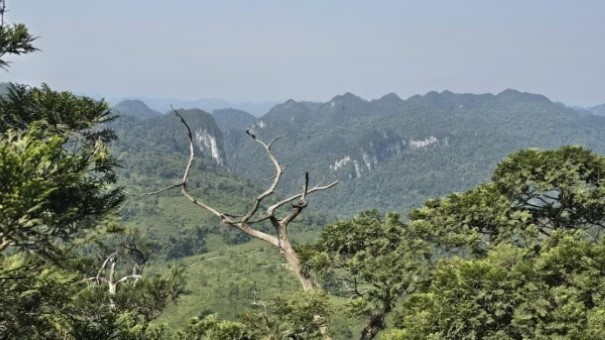
Here, stone does not stand still, and water is not merely there to be admired. The whole complex is a living body of tropical karst: underground water moves through the mountain’s interior, stalactites grow imperceptibly over tens of thousands of years, and primary forest wraps around cave entrances like a green blanket laid over geological memory. It is precisely the remoteness of this landscape that has allowed so much of its value to remain almost untouched.
Not a single cave, but an interconnected world
Seen individually, Kling, Ruc Ca Roong and A Cu each possess a beauty of their own. Yet what matters most is not any one cave in isolation, but the continuity of the entire complex.
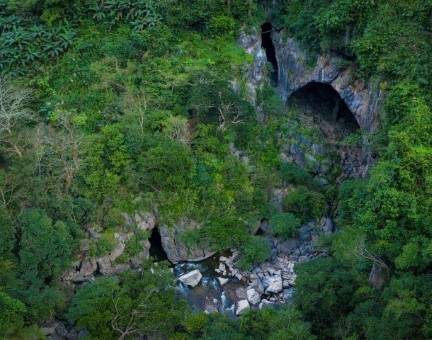
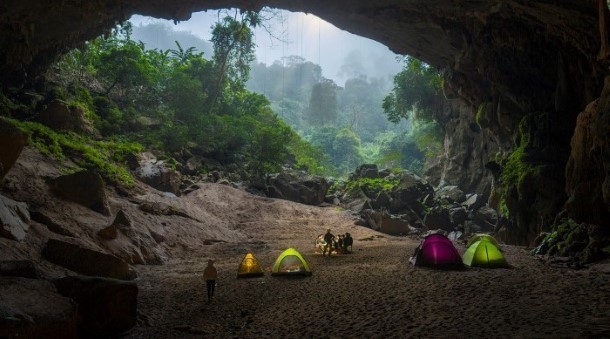
Kling Cave makes an immediate impression through sheer scale. Stretching for roughly one kilometre, it is a through-cave with a broad entrance and a ceiling that rises to around 50 metres in places. Rather than feeling enclosed, Kling resembles a great natural hall. Daylight still filters in, touching soft sand beneath the rock vault and creating a beautiful boundary between the outer world and the kingdom within. A subterranean stream flowing through the cave gives the space not only grandeur, but a sense of breath.
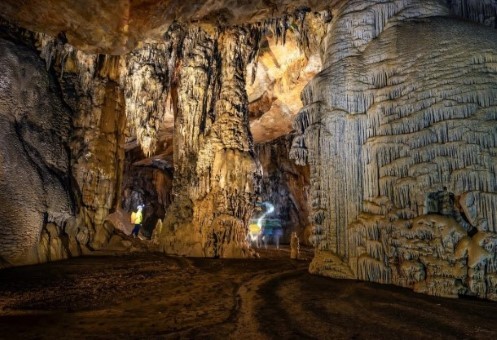
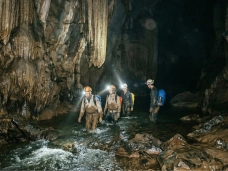
Deeper inside, Kling becomes less a story of size than of form. Stalactites descend from the ceiling, stalagmites rise from the floor, and rough stone surfaces bear the patient mark of water over immense periods of time, giving the impression of walking through an unfinished sculpture gallery shaped by nature itself. There is also the so-called Arem Wall, around 30 metres high — a feature memorable not only for its visual impact, but also for the cultural depth it lends to the landscape.
If Kling is the expansive overture, A Cu feels more like a denser, more intricate musical passage. At around 600 metres in length, the cave stands out for its concentration of stalactites and the succession of rock formations that appear almost from the entrance onward. It does not need dramatic lighting to overwhelm the visitor; rather, it is the compression of space, together with the stone forms created over time by mineral-rich water, that holds one’s attention.
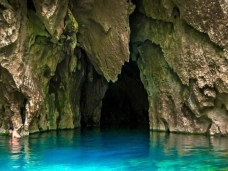
Ruc Ca Roong, by contrast, carries a different tone altogether — quieter, more restrained. Here, solid limestone and clear water combine in a particularly striking way, with the stream winding between great rock masses. If Kling makes one look up, and A Cu invites close inspection, Ruc Ca Roong encourages a slower kind of attention: to the sound of water, to the stillness of the cave, and to the sensation of ancient forest waiting just beyond the stone threshold.
Its greatest value lies not in spectacle, but in integrity
When writing about caves, it is easy to fall back on words such as mysterious, magical or awe-inspiring. They are not wrong. They are simply not enough.
The greatest value of Kling – Ruc Ca Roong – A Cu lies not only in visual beauty, but in the unusually clear relationship it still preserves between karst landform, underground rivers, caves and primary forest. This kind of landscape has been diminished elsewhere by easy access or rapid tourism development. Here, the sense of wilderness still feels real, not staged for visitors.
The ancient stands of Calocedrus rupestris, commonly known as stone cypress, deepen that sense of integrity. Trees that are centuries old cling to steep limestone cliffs, standing not only as ecological highlights, but as symbols of endurance on a harsh geological foundation. Here, trees do not grow “on the ground” in the usual sense; they seem almost to be in direct conversation with the stone itself.
Where nature and human memory meet
A beautiful cave complex may inspire wonder. A beautiful cave complex with human depth is far harder to forget.
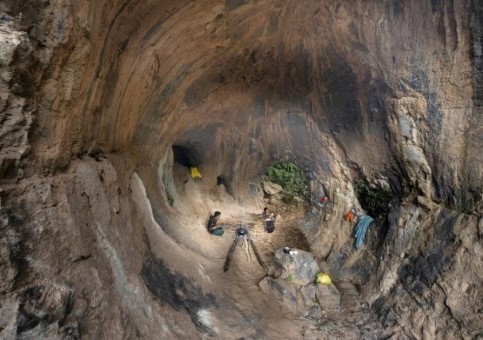
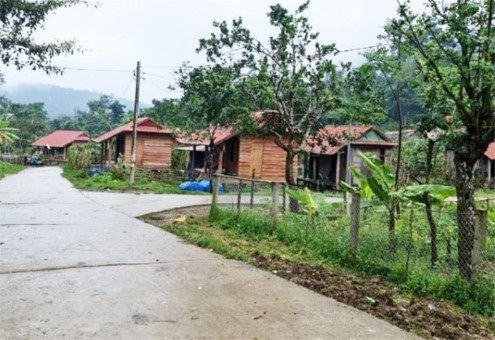
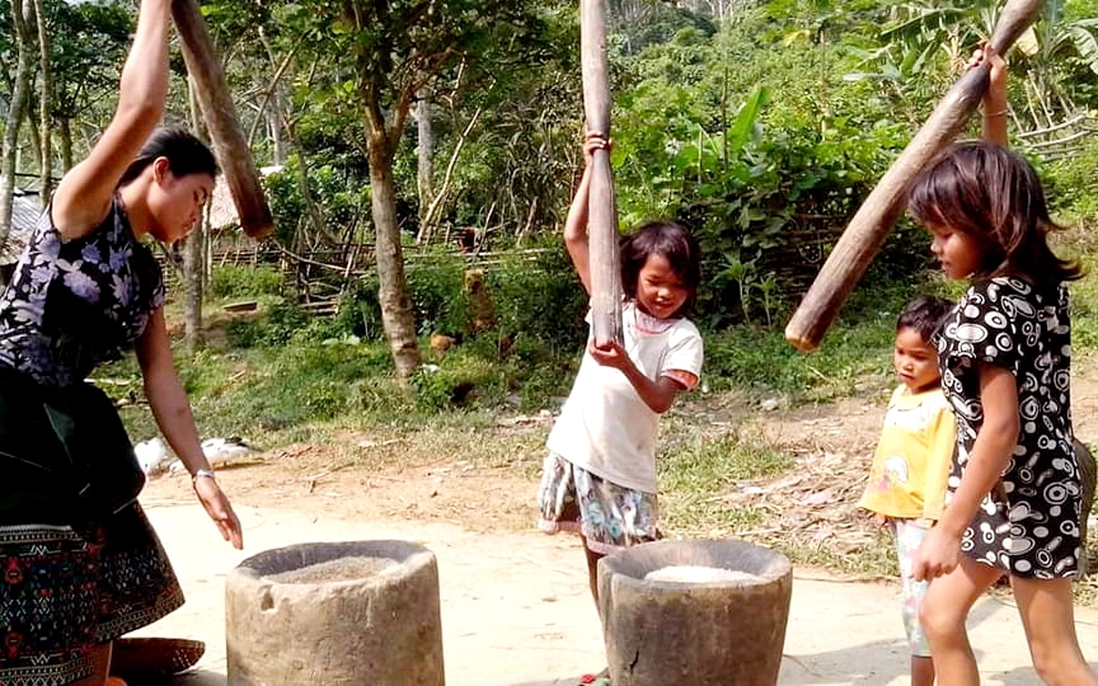
This area also preserves traces of former habitation by the Arem people, a subgroup of the Chut ethnic community. Some rock shelters and caves were once used as places to live and take refuge. That detail matters, because it reminds us that these caves are not merely scenic wonders or geological records. At some point in history, they were also homes — places of shelter and daily life, directly woven into human existence.
To treat Kling – Ruc Ca Roong – A Cu simply as a new check-in location would therefore be to miss half of its meaning. It is not only a place to be looked at; it is a place to be read like a layered text, composed of stone, water, forest and communal memory.
Tourism here should begin with restraint
The area is now being prepared for tourism development through a project linked to the stone cypress forest and Kling Cave. That is a noteworthy signal, but also one that deserves caution. In a landscape whose value lies so deeply in its rawness and integrity, the most suitable path is not mass tourism, but limited, well-managed travel centred on in-depth experience, nature education and heritage interpretation.
A place like this does not need large crowds in order to become meaningful. It simply needs to be told well.
Kling – Ruc Ca Roong – A Cu is not the sort of place that appeals to everyone, nor the kind of destination built for the crowd. It belongs more to those who seek genuine encounters with nature; and the deeper one steps into its story, the clearer it becomes that this is not just a handful of beautiful caves in the forest.
It is an underground heritage landscape, where water has moved through stone longer than a human lifetime can easily imagine, where the forest still keeps watch above the cave mouths, and where people once found shelter in the midst of a demanding natural world.
Some places are visited for pleasure. Some for surprise. And some, like Kling – Ruc Ca Roong – A Cu, are visited in order to understand that the greatest beauty of nature sometimes lies in the fact that it is still entirely itself.
Phong Việt


Comments
Comments (Total 0)
Related Articles

28-08-2026
KIẾN GIANG – DÒNG SÔNG CHỞ KÝ ỨC XỨ LỆ
15-08-2026
Dong Hoi – Cam Ranh: Discover Khanh Hoa 2026

19-06-2026
MINI GAME CHINH PHỤC CỒN CỎ
24-04-2026
DMZ Vietnam Travel Guide 2026









12-12-2025