The Mysteries of Light and Air Inside the Caves of Phong Nha – Ke Bang
08-12-2025 11:03
Võ Văn Trí
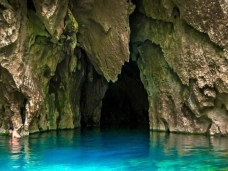
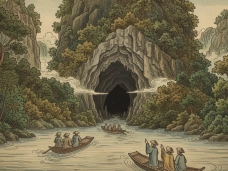
Imagine you are standing on a boat, drifting slowly into Phong Nha Cave. Behind you are the heat, the noise of the living world, and the harsh summer wind;in front of you are cool stone vaults and a dark green ribbon of water leading you into the shadows.
Just a few dozen metres more and you will step into a “parallel world” – where light, air and even time itself seem to follow their own private rules.
The stone gateway and the three zones of light
If you look at a cave entrance with the eyes of a physicist, it is like a “light valve”.Outside, light floods everything; the world is clear and bright.bInside, light is filtered, bent and gradually swallowed by rock, by bends in the passage and by enormous domes, creating three distinct zones of light.
The first zone, right near the entrance, is the bright zone.Here you can still clearly see the green of leaves, moss clinging to the rock, and sometimes even small shrubs taking advantage of the little sunlight that slips in. At wide entrances, such as some of the portals of En Cave, the bright zone and the “half-light” zone behind it can extend for hundreds of metres. In contrast, at narrow entrances like Nuoc Nut Cave, this “twilight of light” lasts only a few dozen metres before fading out completely.
The second zone is the twilight zone – where your eyes have to work harder. Colours fade, everything shifts into shades of grey.You can still see where you are going, but you now begin to need your headlamp.
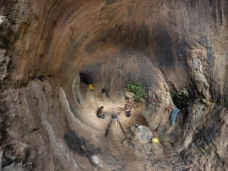
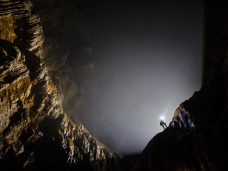
 Three light zones in the caves of Phong Nha – Ke Bang. Photo: Vo Van Tri
Once you cross a certain invisible boundary, you step into the third zone: the zone of permanent darkness. Here, no matter how long you stand to let your eyes “adjust”, if you turn off all the lights, even your own hand in front of your face disappears. There is not a single ray of light strong enough for plants to photosynthesise.This is a world that operates without the sun.
It is precisely this darkness that has forced cave organisms to “redesign” their bodies. Many fish species in the caves of Phong Nha – Ke Bang have lost their eyes completely; some insects and arthropods living deep inside are ghostly white, having lost all pigment, while their antennae and sensory organs are greatly enlarged – as if nature had decided: “Eyes are useless here. What you need are antennas.”
In show caves developed for tourism, humans bring light back in through artificial lighting systems. This is very convenient for our eyes, but it delivers a shock to an ecosystem that evolved in near-total darkness.Around the lamps, green patches of moss and algae often appear – what researchers call lampenflora. They look harmless, but in fact they are invaders.
They depend on the artificial light brought in by humans and, in return, they spread a new biological layer over the rock and speleothems, gradually changing the cave scenery in a way that is no longer “original” as it once was.
A giant air conditioner
When you step into a cave in the middle of a hot summer, your first reaction is often: “Wow, it’s so cool in here!” That feeling is not an illusion.Many caves in Phong Nha – Ke Bang maintain a stable temperature around the low twenties degrees Celsius, much cooler than the scorching air outside. In winter the opposite happens: inside the cave it is often slightly warmer than the outdoor air.
The entire limestone massif acts as a gigantic insulating wall. Heat from outside takes a very long time to penetrate into the interior, so the cave atmosphere does not chase every hot–cold fluctuation of the day. Instead, it tends to hover near the average annual temperature of the region. Walking into a cave is like entering a huge room that has been using the same air conditioner continuously for hundreds or thousands of years.
Humidity inside the cave is also very special. The air is always moist, sometimes so humid that you feel as if you are in a steam room, especially in caves with underground rivers. Yet this cool, windless, highly humid setting is ideal for certain fungi, bacteria and tiny animals. Where humans feel “damp and uncomfortable”, many organisms consider it a paradise.
Alongside temperature and humidity, the story of cave gases is equally fascinating. Cave air is still made up mostly of nitrogen and oxygen, just like outside. However, one minor component plays a very important role: carbon dioxide. The concentration of carbon dioxide in caves is often slightly higher than in the open air, because it is constantly being supplied from the forest soil above, from groundwater seeping through the limestone, and from the respiration of cave-dwelling organisms.
In places with large flocks of birds or bats, such as En Cave, the air even carries a faint “smell of nests” in a very literal sense. Their droppings fall to the cave floor, decompose and release various gases. A simple set of measurements is enough for scientists to detect the “signature” of a vast colony of swiftlets through very small changes in the cave air.
The cave atmosphere also “breathes” with the seasons. In winter, cold winds and temperature differences drive stronger air exchange, helping accumulated gases escape more easily. In summer, when the outside air is hotter than the cave air, the cool cave layer tends to stay put, allowing carbon dioxide to build up.During long periods of heavy rain, water can temporarily seal cracks at the surface. Gases from the soil cannot vent to the open sky and are instead diverted into the caves, causing a rapid but short-lived rise in carbon dioxide levels.
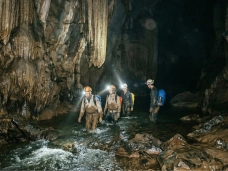
 Light and air shape the cave ecosystem. Photo: Vo Van Tri
The cave’s breath
If you analyse a “breath” of cave air, you still find mostly nitrogen and oxygen – just like outdoors. The good news is that in large caves such as Phong Nha, Paradise, En Cave and Son Doong, oxygen levels remain high enough for ordinary, healthy visitors to breathe comfortably; you will not suddenly “run out of oxygen” on a standard tour.
The gas that changes the most is carbon dioxide. Outside, carbon dioxide makes up only a tiny fraction of the atmosphere, but inside caves this fraction usually creeps higher. In caves with multiple entrances and good ventilation such as En Cave or Son Doong, carbon dioxide levels are only slightly above outdoor background concentrations.
In closed caves with a single entrance, like Tien Son – especially in summer – carbon dioxide can accumulate to significantly higher levels in the deeper sections. Cool cave air is held in place, while carbon dioxide from soil, groundwater and cave organisms continues to be added.
The main source of this carbon dioxide is not tourists, but the forest and soil draped over the limestone massif.Falling leaves, roots and soil microorganisms work tirelessly day after day, year after year, producing carbon dioxide. This gas seeps through cracks and fissures in the rock and eventually “flows” into the cave. Groundwater also carries dissolved carbon dioxide, both helping to dissolve the limestone and later releasing the gas back into the cave air. When drops fall from the cave ceiling to the floor, each drop not only carries minerals to feed stalagmites, but also brings with it the story of gases that originated in the soil above.
Another “supporting actor” in the drama of cave air is nitrogen dioxide. In En Cave, where tens of thousands of swiftlets make their home, their accumulated droppings break down and release nitrogen-rich compounds. Measurements show that nitrogen dioxide concentrations here are higher than in many outdoor locations. From just a few digits on a readout, you can “smell” the presence of an entire bustling city of swiftlets hanging from the cave ceiling.


Comments
Comments (Total 0)
Related Articles
28-08-2026
KIẾN GIANG – DÒNG SÔNG CHỞ KÝ ỨC XỨ LỆ

15-08-2026
Dong Hoi – Cam Ranh: Discover Khanh Hoa 2026

19-06-2026
MINI GAME CHINH PHỤC CỒN CỎ

24-04-2026