


A Two-Day Journey to Khe Sanh from Dong Hoi via the Ho Chi Minh Road West
21-12-2025 16:31
I’ve been back to western Quảng Trị more times than I can count, and it still manages to catch me out. Each visit lands differently. This time I arrived just as the year began to turn—when the light stops showing off and starts telling the truth. A low, grey sky sat over the mountains like a canopy pulled down too close, laying a particular hush across the forest. Summer’s glitter was gone. In its place: the gentle rasp of tyres on a bend, mist beading on the windscreen, the clean, damp scent of leaves and soil. It made me realise that some journeys aren’t about going farther at all. They’re about seeing more clearly—by feeling your way into a landscape rather than simply looking at it.
Day 1 — Leaving Đồng Hới for the land of mist
At 8:00, Đồng Hới felt like a kitchen after the stove has been turned off: the heat of summer no longer trapped in the walls, the air soft and tolerable. We steered out of town and climbed towards the western branch of the Hồ Chí Minh Road, and the city didn’t vanish so much as fade—shrinking in the rear-view mirror as if someone were turning down life’s volume, notch by notch.
By 9:30 we reached Cầu Khỉ, the “Monkey Bridge”, spanning the headwaters of the Long Đại. The name always makes me smile, and not without reason; I’ve seen quick little macaques loitering here like locals who know they own the place. The river below didn’t hurry. It moved with the calm of something certain of its destination—“I’ll reach the sea,” it seemed to say, “so why rush?” From here, the road changes temperament. It begins to coil.
 The headwaters of the Long Đại.
At 11:30 the mountains drew us into their favourite trick: cloud that drops low enough to feel personal. The road folded into bend after bend; mist softened the edges of everything; and the forest thickened into layers, canopy supporting canopy like a crowd leaning in to listen. This is the kind of cold that keeps you awake—clean, damp, and exact. At this time of year, you don’t drive through scenery; you drive through weather. The mist comes with you, quiet as breath, settling lightly on glass and sleeves.
And then, without warning, the forest lets something slip: a waterfall, a white streak falling hard from height to depth—like a piece of cloud dropped by accident. You have just enough time to think, oh, before the next bend pulls it out of sight. The mountains here never let you settle into boredom. They keep changing the frame.
By midday, at Hướng Lập, the world opened a little. The land eased, the sky widened, the light returned. If the earlier stretch felt like walking inside a misty jacket, this was like unzipping it—breathing deeper, seeing farther. Soon we reached the bridge over Sê Păng Hiêng, one tributary feeding the Mekong system. Standing there, you get the sense that this borderland water isn’t merely flowing; it’s travelling—carrying mountain stories onwards to something larger.
 The bridge over Sê Păng Hiêng
Then came Sa Mù, the pass that pins itself to your memory. The road climbs above 1,000 metres and runs for nearly twenty kilometres, a grey ribbon tied along the mountain’s flank. As you rise, the view narrows, and the world edits itself down to essentials: the strip of tarmac ahead, the steady engine note, the quiet spill of mist across everything.
The fog here doesn’t simply hide; it softens, as if someone has smoothed away the landscape’s sharp lines. In places the cloud sits so low you might swear you’ve wandered into a European meadow—Trường Sơn’s own version: grassland opening out, stunted shrubs and low trees bowed under cold wind and damp, growing with the thrift of things that have learned to survive.
 A grass field - Sa Mù
By 13:30 we dropped into Chênh Vênh, a Vân Kiều village that doesn’t try to impress you. It sits quietly on the slope like a small sentence—easily missed unless you listen properly. Houses are neat, gardens simple, and there’s a feeling of “enough” that makes you want to stop scrolling. Some places demand photos.
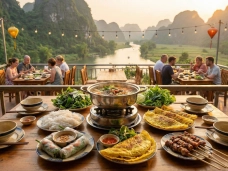
Chênh Vênh asks for your full attention instead. Its beauty isn’t sparkly; it’s enduring—like old wood, warmer the longer you look. If you stop, do it properly: book ahead at Đoong Bui Homestay and eat what the land offers—stream fish, forest bamboo shoots.... The food is plain in the best way: made slowly, without fuss, tasting of where you are.
 Lunch at Đoong Bui Homestay
At 15:00 we reached Hướng Phùng, where the highland air feels freshly rinsed. Pun coffee appeared at exactly the right moment—because a mountain road without a decent cup is like climbing Sa Mù and never meeting the mist. Pun is the real thing: one sip and you know it isn’t trying to please you with sugar or flavouring. It’s strong but not harsh, aromatic but not showy. I like to joke that it tastes of earth and sky—earth giving depth and body, sky giving clarity and a long, clean finish. It doesn’t jolt you awake; it brightens you gently.
 Coffee at Hướng Phùng
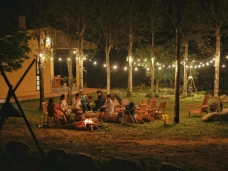
By 17:30, back at the Five Season Bungalow, the cold began to speak. Highland cold isn’t like city cold. It doesn’t rush in noisily; it arrives slowly, like a cool hand on the shoulder, reminding you to add a layer—and to slow your words. And in that cold, warmth shows up in other forms: the relief of sitting still after a long day, the small miracle of seeing your breath, the wind moving through trees as if it’s telling a story. In the city you sleep to recover.
Five Season Bungalow you sleep to quieten—letting the noise in your head settle until morning arrives a little lighter.
 Night at Five Season Bungalow
Day 2 — From still water to the weight of history
By 9:30 we were heading for Rào Quán Lake and Phong Hương Forest. The road is hilly but manageable, a steady descent that feels like returning to a normal rhythm of breath. Small roadside settlements make a thoughtful pause—an introduction to Vân Kiều livelihoods and the forest’s quiet economy: fern tips, bamboo shoots, rattan, and the careful ways people make do with what the mountains give.
Rào Quán isn’t a place that begs to be “checked in”. It holds you with stillness. The water lies flat and deep, and when a light wind passes it barely wrinkles the surface—then everything settles again, like a sigh someone doesn’t want to explain. From the lake into Phong Hương, the air changes immediately: wet leaves, soil, forest after mist. Weak winter light slips through the canopy in thin threads and falls across the path. The reds have mostly gone this season, leaves scattered underfoot, yet the beauty remains—quiet, unperformed. Here, you don’t feel like talking. You walk slowly, listening to your own footsteps, and you understand something simple: peace sometimes comes from being still in the right place.

Rào Quán View
Later, Làng Vây brought the past closer. The memory of the Vietnam War here isn’t presented as dry facts; it feels like sediment—layered into the ground, into the space, into the stories spoken in voices that don’t need to raise themselves. Time doesn’t move in a straight line at Làng Vây. It loops back, brushes the present, then continues on, leaving you with a silence that feels like respect.
 Làng Vây - Historic Evedence
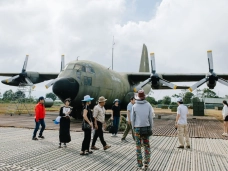
At Tà Cơn airbase, history sits in a different way—quiet but undeniable, accumulated rather than explained. The first thing that meets you is the emptiness: a wide openness where you can hear the wind passing through. War, I thought, isn’t only gunfire and explosions. It’s the people who once stood under a sky like this—carrying fear, hope, or simply the wish to live. Today the sky is the same. The wind is the same. But the person standing beneath it is different. Perhaps that is how time heals: it doesn’t erase; it simply places everything at the right distance, so we can look, understand, and feel grateful
 Tà Cơn Airbase
Two days from Đồng Hới to Khe Sanh passed as quickly as a thin layer of mist, but the aftertaste was deep. From Monkey Bridge and the mist-wrapped forest road to Sê Păng Hiêng and the Sa Mù pass, it felt as though I’d travelled through the layers of a place: green forest, grey cloud, quiet villages, and then—at the end—those historical sites that ask for nothing except your attention. In Hướng Phùng, a cup of Pun tasted like the essence of earth and sky: waking the mind without sharpening it. Rào Quán and Phong Hương reminded me that peace can be ordinary—sometimes as simple as standing still, in the right place. And Tà Cơn and Làng Vây closed the journey with a silence that lingered—enough to make you grateful for the fact that today, we can travel these mountains in peace.
Tours to Khe Sanh
Tuệ Minh


Comments
Comments (Total 1)
Daniel
14-03-2026
Related Articles
28-08-2026
KIẾN GIANG – DÒNG SÔNG CHỞ KÝ ỨC XỨ LỆ
15-08-2026
Dong Hoi – Cam Ranh: Discover Khanh Hoa 2026

19-06-2026
MINI GAME CHINH PHỤC CỒN CỎ
24-04-2026
DMZ Vietnam Travel Guide 2026

12-12-2025