


Dong Hoi – Cam Ranh: Discover Khanh Hoa 2026
15-08-2026 17:13
Main contents
- 1. Dong Hoi – Cam Ranh is one of those journeys.
- 2. Dong Hoi – Cam Ranh: Connecting Caves with the Ocean
- 3. Cam Ranh – Where Khanh Hoa Begins in Blue
- 4. Nha Trang – A City That Lives with the Sea
- 5. Khanh Hoa Is More Than Nha Trang
- 6. Hon Mun – Discover Khanh Hoa Beneath the Surface
- 7. Another Khanh Hoa Lies Beyond the Beach
- 8. To Understand Khanh Hoa, Start with Breakfast
- 9. Edible Bird's Nest – A Delicacy with a Story Written in the Islands
- 10. Po Nagar Cham Towers – Where the Past Is Still Alive
- 11. From Kauthara to Khanh Hoa Today
- 12. How Many Days Do You Need in Khanh Hoa from Dong Hoi?
- 13. Dong Hoi – Cam Ranh Flight Schedule
In just around 1 hour and 20 minutes from Dong Hoi, you can travel from the forests and caves of Phong Nha–Ke Bang to the blue coast of Khanh Hoa. The new Dong Hoi – Cam Ranh air route, scheduled to begin on 16 August 2026, does more than shorten the distance. It opens up a new way to experience two remarkably different sides of Vietnam in a single journey.
Some journeys begin with a plan.
Others begin simply because a new route has appeared on the map.
Dong Hoi – Cam Ranh is one of those journeys.
From 16 August 2026, the Dong Hoi – Cam Ranh route is scheduled to operate three return flights a week, on Tuesdays, Fridays and Sundays. The flight departs Dong Hoi at 12:05 and arrives in Cam Ranh at 13:25.
Around 1 hour and 20 minutes in the air.
But the real story is not simply the flying time.
It is how completely the landscape changes.
In the morning, you could still be in Phong Nha, surrounded by tropical forest, underground rivers and ancient limestone mountains. By early afternoon, the aircraft doors open onto another world: sunshine, sea, sweeping blue bays and mountains running close to the coast.
If Phong Nha is a journey into the Earth, Khanh Hoa is a journey towards the ocean.
And now, these two worlds are only one flight apart.
Dong Hoi – Cam Ranh: Connecting Caves with the Ocean
The most exciting thing about the new route is not simply the time it saves.
It is what lies at either end of the journey.
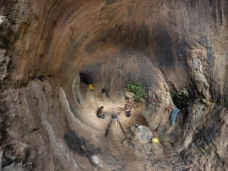
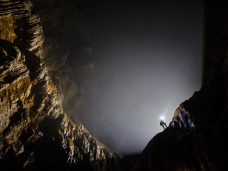
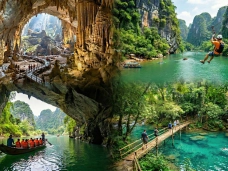
Dong Hoi is the gateway to Phong Nha–Ke Bang – a world of caves, limestone mountains, tropical forests and rivers flowing through the heart of the karst.
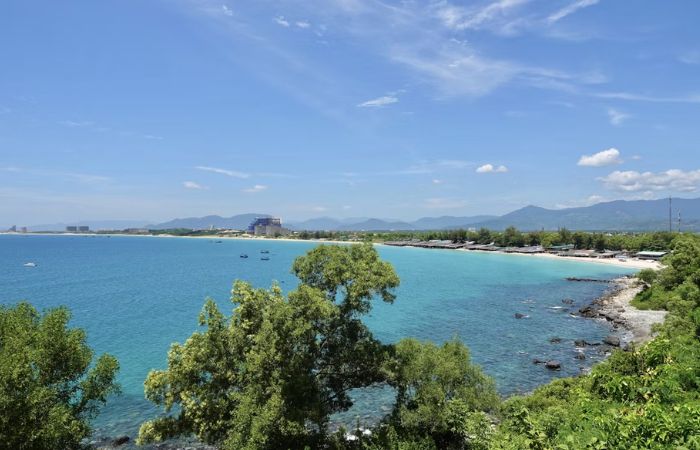
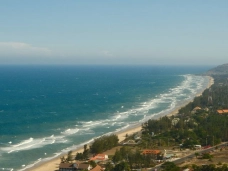
Cam Ranh opens onto an almost opposite landscape: sea, islands, sandy beaches, sweeping bays and a coastal culture shaped over centuries.
Together, they create an unusual journey:
Forest → Caves → Dong Hoi → Cam Ranh → Sea → Islands → Cham Culture.
You no longer have to choose between Phong Nha and Khanh Hoa.
You can experience both.
Cam Ranh – Where Khanh Hoa Begins in Blue
Before thinking about Nha Trang, take a moment to discover Cam Ranh.
Even from the air, the landscape begins to tell its story: mountains approach the coast, peninsulas reach into the water and shades of blue appear between the land and the ocean.
Do not think of Cam Ranh simply as the location of the airport on your way to Nha Trang.
Bai Dai, or Long Beach, is an ideal place to begin your journey at a slower pace: sand, sea and a horizon wide enough to make you forget your itinerary for a while.
After a flight, the best experience is not always rushing towards the first attraction on your list.
Put down your luggage.
Walk towards the sea.
And let the holiday truly begin.
Nha Trang – A City That Lives with the Sea
From Cam Ranh towards Nha Trang, the sea gradually becomes your travelling companion.
What makes Nha Trang different from many coastal cities is the way the ocean is woven into everyday urban life.
Early in the morning, local people are already swimming. Runners make their way along the seafront. Offshore, fishing boats continue to move across the water.
By late afternoon, the beach once again becomes an enormous communal space.
To experience Nha Trang, you do not necessarily need a packed sightseeing itinerary.
Wake up early, walk along the coast, find a breakfast place busy with local people, order a bowl of fish noodle soup and watch the city begin another day.
Ordinary moments like these can sometimes tell you more about a city than a long list of places to photograph.
Khanh Hoa Is More Than Nha Trang
This may be the most important thing to remember when exploring the province.
Nha Trang is so famous that its name can sometimes overshadow the rest of Khanh Hoa.
But open the map.
From Cam Ranh and Nha Trang to Ninh Hoa and Van Phong lies a chain of remarkably different coastal landscapes.
Some are made for relaxing holidays.
Some are gateways to island adventures.
Others offer wider, quieter beaches.
And there are coastal areas where the most memorable experience is not found in a tourist resort at all, but in the landscape and the everyday life of local communities.
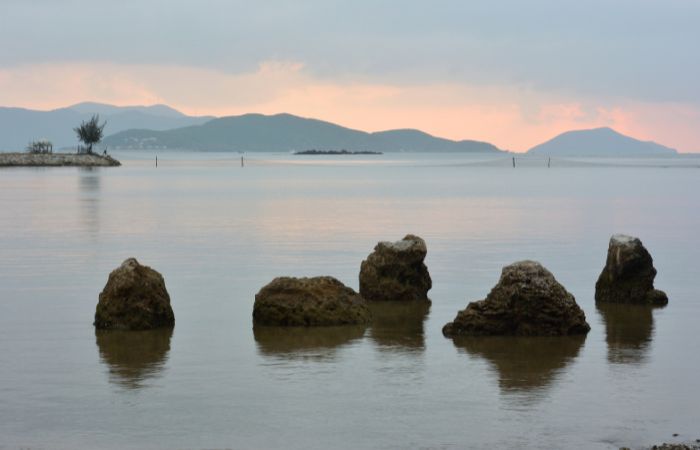
Doc Let has a very different character from Nha Trang. Van Phong Bay opens onto a much broader landscape of sea, islands, peninsulas and mountains that add depth to the horizon.
Travel a little beyond the main tourist centres and Khanh Hoa stops being simply somewhere to take a beach holiday.
It becomes a place to explore.
Hon Mun – Discover Khanh Hoa Beneath the Surface
To understand a coastal region, sometimes you need to leave the mainland behind.
From Nha Trang, boat trips into the bay leave the city gradually shrinking behind you. Ahead lie Hon Tre, Hon Tam, Hon Mieu, Hon Mot, Hon Mun and an entirely different world beneath the surface.
Here, the landscape is no longer shaped by streets or buildings.
It is shaped by water, light, fish and coral reefs.
Diving and snorkelling are therefore more than recreational activities. They offer a chance to discover a side of Khanh Hoa that cannot be seen from the shore.
But this is also where tourism must go hand in hand with responsibility.
Do not step on coral. Do not take marine life home as souvenirs. Do not leave rubbish behind.
A good journey is not only about returning with beautiful photographs.
It is also about leaving a destination without making it poorer than when you arrived.
Another Khanh Hoa Lies Beyond the Beach
The coast is so famous that it is easy to forget that behind Khanh Hoa's shoreline lie mountains, rivers, streams and ecosystems connecting the mainland with the ocean.
Move inland and the landscape can change surprisingly quickly.
That is one reason why spending several days in Khanh Hoa does not mean repeating the same experience every day.
One morning could be spent on an island.
The next day could take you towards the mountains and natural landscapes inland.
By evening, you can be back in the city, sitting in front of a steaming bowl of fish noodle soup.
Khanh Hoa is attractive not simply because it has beautiful beaches. The sea is only the first layer of this remarkable destination.
To Understand Khanh Hoa, Start with Breakfast
There is a simple way to begin understanding a city:
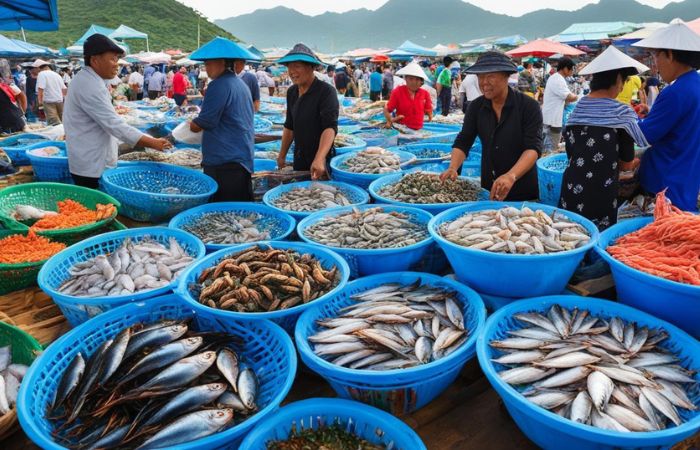
Visit its markets and eat breakfast with the locals.
In Khanh Hoa, fish is not simply seafood served to tourists.
It appears in breakfast noodles, is made into fish cakes, flavours broths, forms part of everyday family meals and travels directly from fishing boats to markets along the coast.
The food here carries the geography of the region within it.
Fish Noodle Soup and Fish-Cake Noodles – Flavours of a Coastal City
A good bowl of Nha Trang fish noodle soup does not need to be complicated.
A light broth, fish, fish cakes, noodles and fresh vegetables are enough.
Its simplicity is precisely what makes it memorable.
The fish cakes have a pleasantly firm texture and the natural sweetness of fresh fish, while banh canh cha ca – thick noodle soup with fish cakes – is richer, warmer and particularly satisfying after a long day by the sea.
These are not dishes that need elaborate presentation for photographs.
They are at their best served hot.
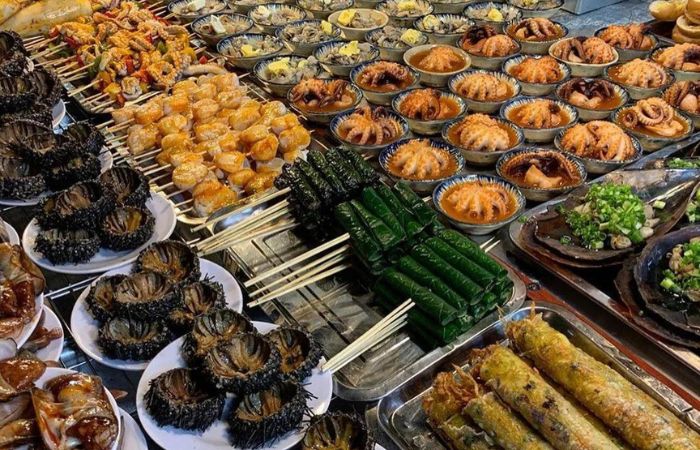
Banh Can – Best Enjoyed Beside the Stove
These small rice-flour cakes arrive straight from their moulds, lightly crisp around the edges and still soft inside.
Egg, squid, prawns and other toppings give each version a slightly different character.
But half the pleasure of banh can lies beyond the food itself.
It is sitting beside the stove, watching the cook pour another batch into the small moulds, listening to them sizzle and waiting for the next plate to arrive.
Some dishes need a beautiful restaurant.
Banh can needs a seat beside the stove.
Ninh Hoa Nem – When a Dish Carries the Name of Its Home
Travel north towards Ninh Hoa and another name becomes part of Khanh Hoa's culinary story: nem Ninh Hoa.
If your itinerary allows, try it in the very place that gave the speciality its name.
The difference between “trying a local speciality” and “experiencing local food culture” can sometimes be as simple as being willing to travel a little beyond the familiar tourist areas.
Edible Bird's Nest – A Delicacy with a Story Written in the Islands
Khanh Hoa is also famous for another distinctive product: edible bird's nest.
But seeing it simply as a valuable delicacy reveals only part of the story.
Behind it are rocky islands, swiftlet caves, traditional harvesting practices and knowledge accumulated over generations.
Look deeply enough and food stops answering only the question “What should I eat?”
It begins to answer bigger questions:
What natural resources have supported local communities?
How has the sea shaped local livelihoods?
And how have generations of people learnt to adapt to life beside the ocean?
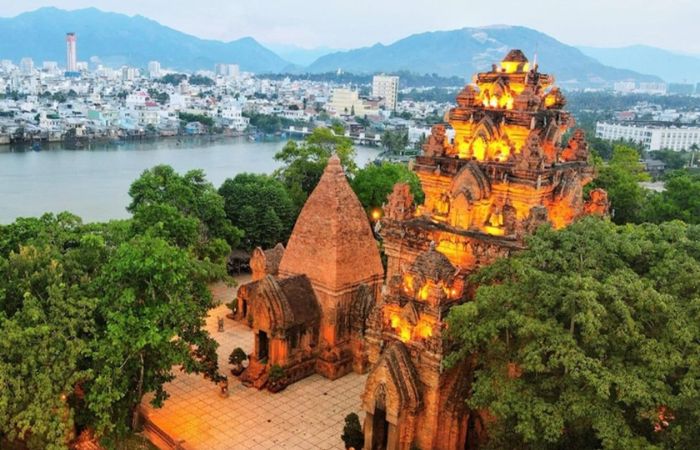
Po Nagar Cham Towers – Where the Past Is Still Alive
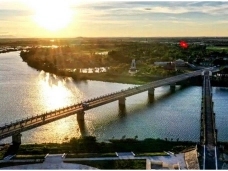
Leave the beach and head towards the mouth of the Cai River, and another side of Khanh Hoa begins to emerge.
On Cu Lao Hill stand the red-brick towers of Po Nagar.
Below, Nha Trang continues to move.
Traffic still passes.
The river still flows.
The sea remains visible in the distance.
But step into the temple complex and time seems to move at a different pace.
The Po Nagar complex was built by the Cham over several periods, from around the eighth to the thirteenth centuries, and is associated with the worship of Po Nagar, the Mother Goddess of the Land.
Through centuries of cultural contact and coexistence, this tradition also became intertwined with Vietnamese worship of the goddess Thien Y A Na.
What makes Po Nagar remarkable, therefore, is not simply the age of its bricks.
This is not a monument whose story has ended.
People still come here to worship. Festivals continue to take place. Beliefs and traditions continue to be passed from one generation to another.
At Po Nagar, the past is not locked behind museum glass. The past is still alive.
From Kauthara to Khanh Hoa Today
To understand Po Nagar more deeply, it helps to look beyond the towers themselves.
The area that is now Khanh Hoa was once part of the Cham region of Kauthara. This historical context helps explain why Cham culture is not simply a decorative detail in the story of Khanh Hoa.
It is an important layer of the region's history.
Temple architecture, sculpture, beliefs, festivals and stories passed through generations reveal a coastal region shaped by far more than scenery.
The sea brought people.
Rivers created places to settle.
Trade connected communities.
And culture accumulated over time.
If the sea allows us to see Khanh Hoa through colour, Cham culture allows us to see it through the depth of time.
How Many Days Do You Need in Khanh Hoa from Dong Hoi?
Flights on Tuesdays, Fridays and Sundays create several convenient options for a short holiday.
3 Days / 2 Nights – Ideal for a Short Break
Fly Friday to Sunday or Sunday to Tuesday.
This works well if your main focus is Cam Ranh and Nha Trang, with time for the beach, local cuisine and a visit to Po Nagar and the city.
4 Days / 3 Nights – The Most Balanced Option
Fly Tuesday to Friday.
This gives you enough time to combine Cam Ranh, Nha Trang, a day exploring the islands, local cuisine and Cham culture without having to rush from one place to another.
5 Days / 4 Nights or Longer – Explore Beyond Nha Trang
With more time, extend your journey towards Ninh Hoa, Doc Let and Van Phong, or spend longer discovering the region's natural landscapes and local communities.
A good journey is not necessarily the one that includes the greatest number of attractions.
It is the one where, after returning home, you can still remember each place through its landscape, food, people and stories.
Dong Hoi – Cam Ranh Flight Schedule
Connecting the caves and forests of Phong Nha–Ke Bang with the blue coast of Khanh Hoa. The route is scheduled to operate from 16 August 2026.
Dong Hoi – Cam Ranh Flight Schedule 2026
| Route | Operating Days | Departure | Arrival | Flight Time |
|---|---|---|---|---|
| Dong Hoi (VDH) → Cam Ranh (CXR) | Tuesday, Friday, Sunday | 12:05 | 13:25 | Approx. 1 hr 20 min |
| Cam Ranh (CXR) → Dong Hoi (VDH) | Tuesday, Friday, Sunday | 14:05 | 15:30 | Approx. 1 hr 25 min |
From Caves to the Ocean – Just One Flight Away
Explore the caves and tropical forests of Phong Nha–Ke Bang in the morning, and by early afternoon you could be beside the blue waters of Khanh Hoa. The Dong Hoi – Cam Ranh route opens up a remarkable journey combining Phong Nha, Quang Tri – Cam Ranh – Nha Trang – islands – local cuisine – Cham culture in one unforgettable trip.


Comments
Comments (Total 1)
Phong Nha Việt
16-08-2026
Related Articles
28-08-2026
KIẾN GIANG – DÒNG SÔNG CHỞ KÝ ỨC XỨ LỆ

19-06-2026
MINI GAME CHINH PHỤC CỒN CỎ
24-04-2026
DMZ Vietnam Travel Guide 2026




12-12-2025