


The Spheres of the Earth and Their Relationship with the Five Phases
06-06-2026 09:18
Main contents
- 1. Introduction
- 2. The Four Main Spheres of the Earth
- 3. The Relationship Between the Four Main Spheres and the Five Phases
- 4. Mutual Generation from the Perspective of the Earth System
- 5. Mutual Regulation as a Mechanism of Balance
- 6. Scientific–Five Phases Comparison Table
- 7. The Ecological Meaning of This Approach
- 8. Conclusion
Võ Văn Trí
Introduction
The Earth is not a loose collection of land, water, air and living organisms. It is an integrated system in which material and energy components constantly interact, exchange and regulate one another. Earth System Science studies the planet from this perspective: not by looking at each element separately, but by seeing the Earth as a whole made up of many interconnected spheres.
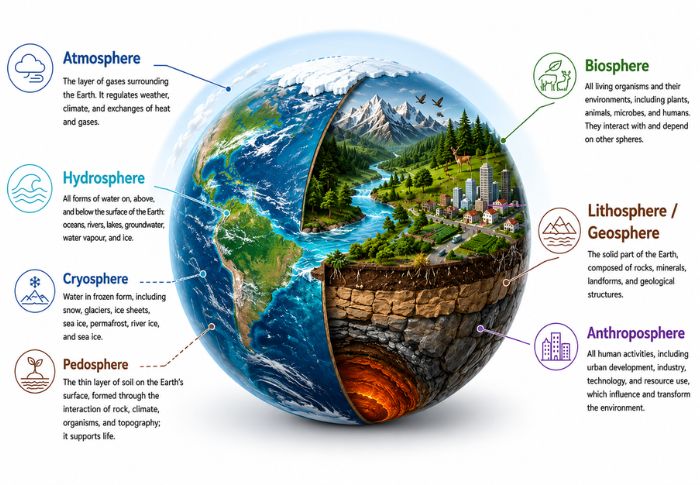
In its fundamental classification, the Earth is commonly divided into four main spheres: the atmosphere, the hydrosphere, the lithosphere or geosphere, and the biosphere. These four spheres correspond to four major domains of the planet: air, water, rocks and landforms, and life. Other spheres such as the cryosphere, pedosphere and anthroposphere may be separated in specialised studies, but they should not be rigidly placed on the same level as the four main spheres. The cryosphere is the frozen-water component of the hydrosphere; the pedosphere is the soil layer that develops upon the lithosphere; and the anthroposphere is the distinctive sphere of human activity, which originates from the biosphere but exerts strong impacts on the entire Earth system.
The Five Phases consist of Wood, Fire, Earth, Metal and Water. They form an ancient Eastern system of thought used to interpret the movement, transformation and balance of nature. In this article, the Five Phases are not regarded as a scientific model that replaces geology, climatology or ecology. They are used as a symbolic framework to help us look more deeply at the relationships among the Earth’s spheres, especially the principles of mutual generation, mutual regulation and systemic balance.
The Four Main Spheres of the Earth
The atmosphere is the layer of air surrounding the Earth. It is where weather, climate, wind, clouds, rain, heat exchange and atmospheric chemical processes take place. The atmosphere protects life from many harmful influences from space, while also playing a role in regulating the temperature of the planet’s surface. Without the atmosphere, the Earth would have no weather, no rain and no thermal stability necessary for life.
The hydrosphere includes all water on Earth: oceans, rivers, lakes, groundwater, water vapour, snow and ice, and water within living organisms. Water does not remain still; it moves through the water cycle: evaporation, condensation, falling as rain or snow, infiltrating into the ground, flowing into rivers and seas, and then continuing to circulate. The hydrosphere is the system that transports heat, nutrients, sediments and energy between different regions of the planet.
The lithosphere or geosphere is the solid material part of the Earth, including the Earth’s crust, rocks, minerals, landforms, mountains, plains, ocean floors and tectonic processes. It is the deep material foundation of landscapes, mineral resources, soils and geomorphology. Volcanoes, earthquakes, plate tectonics, weathering and erosion all belong to lithospheric processes.
The biosphere is the totality of life on Earth, including plants, animals, microorganisms, fungi and human beings as a biological species. The biosphere does not merely “live on” the Earth; it also participates in transforming the Earth. Plants produce oxygen through photosynthesis, decomposers contribute to soil formation, forests regulate water and climate, and microorganisms participate in the carbon, nitrogen and many other biogeochemical cycles.
These four spheres do not exist independently. Rain from the atmosphere falls onto the lithosphere, creates flows within the hydrosphere and nourishes the biosphere. Green plants in the biosphere absorb carbon dioxide from the atmosphere, take up water from the hydrosphere and obtain minerals from the lithosphere. Rocks are weathered by water and wind into soil; soil then nourishes plants; plants hold soil, retain water and regulate climate. It is this interconnection that gives the Earth its systemic nature.
Beyond the four main spheres — the atmosphere, hydrosphere, lithosphere and biosphere — scientists also refer, in specialised studies, to a number of subsystems such as the cryosphere, pedosphere and anthroposphere. These subsystems are not entirely separate from the four main spheres; rather, they are distinctive components or zones of interaction that are separated out in order to analyse more clearly some important processes of the Earth system.
The cryosphere is the frozen-water component of the hydrosphere, including polar ice, glaciers, snow cover, sea ice and frozen ground. In essence, the cryosphere belongs to the hydrosphere. However, because it plays a major role in reflecting solar radiation, regulating climate, storing freshwater and influencing sea level, it is often studied separately in research on climate and global change.
The pedosphere is the soil layer on the land surface, formed mainly through the weathering of parent rock from the lithosphere. However, soil is not merely a product of rock; it is also where water, air, organic matter, plant roots and microorganisms come together. The pedosphere is therefore linked to the lithosphere while also acting as a zone of interaction among the lithosphere, hydrosphere, atmosphere and biosphere. It is an important transitional layer where inorganic matter is transformed into a medium that nourishes life.
The anthroposphere or technosphere is a concept used to refer to the imprint and activity of human beings within the Earth system, including cities, agriculture, industry, transport, energy, technology, resource extraction and waste. Biologically, human beings belong to the biosphere. However, in the present age, human activity has had profound impacts on the atmosphere, hydrosphere, lithosphere and the entire biosphere. The anthroposphere can therefore be understood as a distinctive aspect of the biosphere at a time when human beings have become a force capable of strongly transforming the Earth system.
Thus, the scientifically sound structure is as follows: the four main spheres form the foundational framework of the Earth system, while the cryosphere, pedosphere and anthroposphere are subsystems or specialised analytical layers used to examine zones of interaction, special states of matter and prominent impacts in the functioning of the planet.
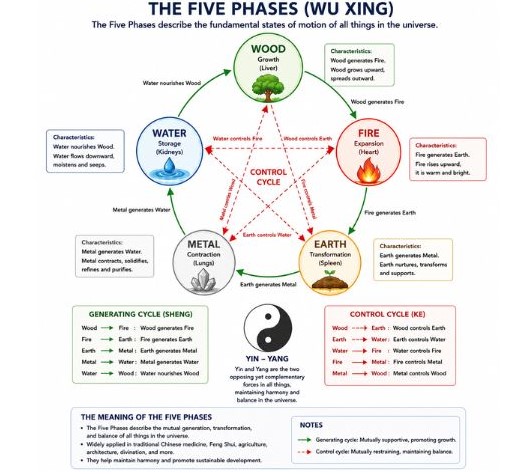
The Five Phases should not be understood simply as five concrete materials. Wood is not only trees; Fire is not only flame; Earth is not only soil; Metal is not only metal; Water is not only water. In the depth of Eastern philosophy, the Five Phases are five principles of movement.
Wood represents growth, germination, rising movement, renewal and development. Fire represents energy, heat, light, upward movement, transformation and eruption. Earth represents foundation, receptivity, nourishment, mediation and stability. Metal represents structure, minerals, limits, order, condensation and crystallisation. Water represents flow, penetration, softness, adaptability, storage and circulation.
If Earth science explains the mechanisms of planetary operation through observation, data and models, the Five Phases can help express the spirit of natural balance in a more intuitive way. However, it should be emphasised that the Five Phases here are only a philosophical and ecological interpretive framework, not scientific evidence in the experimental sense.
The Relationship Between the Four Main Spheres and the Five Phases
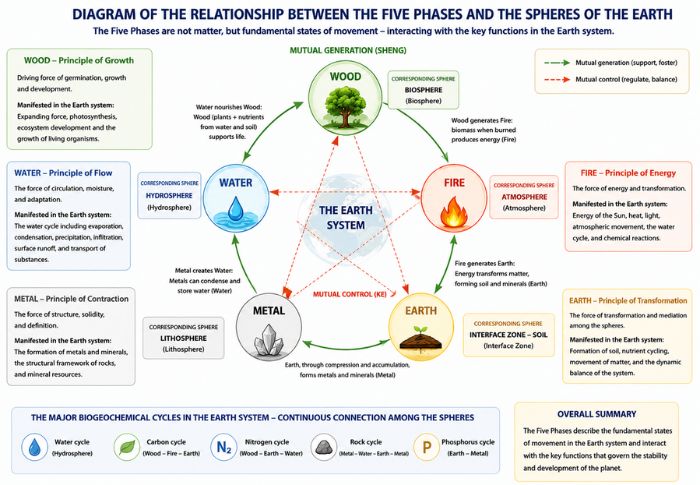
The biosphere corresponds most strongly with the Wood phase. This is the sphere of life, growth and regeneration. Plants photosynthesise, create biomass, absorb carbon dioxide and release oxygen. Forests, grasslands, microorganisms, animals and human beings all belong to the living network of the biosphere. Wood here is not only trees, but the principle of life: germination, development, connection, recovery and evolution.
The hydrosphere corresponds most strongly with the Water phase. Water has the capacity to flow, permeate, dissolve, transport, cool and circulate. The water cycle is one of the clearest pieces of evidence for the Water quality of the Earth system: water evaporates from the sea into the atmosphere, condenses into clouds, falls as rain, flows through rivers and streams, seeps into the ground and returns to the ocean. The cryosphere, when mentioned, should be understood as a special state of Water: water in a stored, condensed and climate-regulating form.
The lithosphere corresponds to both Metal and Earth. Metal is expressed in rocks, minerals, metals, crystals, geological structures and the crystallisation of matter over long periods of time. Earth is expressed in the ground, landforms, weathered layers and the capacity to support life. When rock is weathered into soil, the lithosphere gradually shifts from the firmness of Metal towards the nourishment of Earth. The pedosphere is therefore a very important part of the relationship among Metal, Earth, Water and Wood.
The atmosphere should not be assigned to only one phase. It carries Fire through heat, light, solar radiation and the movement of energy; Water through water vapour, clouds, rain and humidity; and Metal through atmospheric layers, pressure, gas composition and the laws of motion. The atmosphere is where the phases intersect most clearly, because weather and climate are always the result of energy, water, matter and movement.
If placed within the Five Phases framework, the anthroposphere has its root in Wood because human beings are living organisms within the biosphere. Yet modern society strongly highlights Metal and Fire: Metal through tools, machinery, concrete, metals, cities and technology; Fire through energy, industry, electricity, engines and consumption. When Metal and Fire develop excessively, they can weaken Wood, disturb Water, damage Earth and alter the atmosphere.
Mutual Generation from the Perspective of the Earth System
In the Five Phases, mutual generation is a relationship of support and nourishment. If interpreted through the language of Earth System Science, mutual generation can be understood as functional interdependence among the spheres.
Water generates Wood: water is a basic condition for life. Without water, plants cannot photosynthesise, soil cannot maintain moisture, and living organisms cannot survive. The water cycle nourishes the biosphere and sustains ecosystems.
Wood generates Fire: biomass stores solar energy through photosynthesis. Wood, leaves, peat, coal and other forms of organic matter all express biologically stored energy. When burned or decomposed, that energy is released.
Fire generates Earth: energy and heat participate in many processes of material formation and transformation. Volcanic eruptions create ash and new rock; over time, volcanic materials can weather into fertile soil. Light and heat also drive biological processes in soil.
Earth generates Metal: within soil and rock, over geological time, minerals and metals are formed, accumulated and crystallised. Soil and rock are environments that contain mineral elements.
Metal generates Water: geological structures determine where water infiltrates, is stored and emerges. Fractured rocks, karst caves, aquifers and minerals in rocks all influence water flow and water quality.
This interpretation does not mean that the Five Phases replace science. Rather, it shows that ancient Eastern thought can be reread as a symbolic model of interdependence in nature.
Mutual Regulation as a Mechanism of Balance
Mutual regulation should not be understood simply as destruction. In nature, it is closer to regulation, limitation and control. A sustainable system is not one in which every factor grows without limit, but one in which factors restrain one another in order to maintain balance.
Water regulates Fire: water cools, moderates heat, extinguishes fire and reduces thermal extremes. The oceans absorb a large proportion of the Earth’s heat, rain eases drought, and humidity influences climate.
Fire regulates Metal: heat can alter the structure of matter. In geology, high temperature causes rocks to undergo metamorphism, magma melts materials, and volcanic activity reshapes the Earth’s surface.
Metal regulates Wood: hard structures, rocky terrain, mineral-poor ground or industrial intervention can limit the growth of living organisms. In modern society, Metal also refers to tools, machinery, extraction and concretisation, which reduce the living space of Wood.
Wood regulates Earth: roots penetrate soil, living organisms use nutrients in soil, and vegetation changes soil structure. Yet in a positive sense, Wood also holds soil in place, prevents erosion and makes soil more alive.
Earth regulates Water: soil and rock can retain water, filter water, block flows and regulate groundwater. When soil is degraded or sealed under concrete, its capacity to regulate Water declines, increasing the risk of flooding, drought and water pollution.
Thus, mutual regulation is the principle of limits. Without limits, Fire can become wildfire and extreme warming; Water can become flooding; Wood can become ecological imbalance; Metal can become excessive extraction; and Earth can become dryness or obstruction of natural flows.
Scientific–Five Phases Comparison Table
| Scientific system | Position within the Earth system | Main corresponding phase | Interpretive meaning |
|---|---|---|---|
| Biosphere | One of the four main spheres | Wood | Life, growth, regeneration, photosynthesis, biodiversity |
| Hydrosphere | One of the four main spheres | Water | Water, flow, circulation, storage, adaptability |
| Lithosphere/Geosphere | One of the four main spheres | Metal – Earth | Rocks, minerals, structure, foundation, landforms, parent material |
| Atmosphere | One of the four main spheres | Fire – Water – Metal | Heat, light, water vapour, wind, clouds, climatic order |
| Cryosphere | The frozen-water component of the hydrosphere; separated in climate studies | Water | Water in solid form, storage, cooling, radiation reflection |
| Pedosphere | The soil layer on the outer part of the lithosphere; a zone of interaction among several spheres | Earth | Living soil, nourishment, transformation, ecological mediation |
| Anthroposphere/Technosphere | A distinctive aspect of the biosphere in an age when human beings strongly affect the Earth | Metal – Fire, rooted in Wood | Technology, cities, energy, industry, environmental impact |
The Ecological Meaning of This Approach
This combined perspective of Earth science and the Five Phases emphasises one point: the environment is an interconnected system. Deforestation is not only the loss of trees; it is also the weakening of Wood, the disturbance of Water, the damage of Earth, the alteration of the atmosphere and the intensification of climatic extremes. Water pollution is not only a Water issue; it also affects the biosphere, soil, human health and the entire circulation of matter. Excessive mineral extraction does not only affect Metal; it also deforms the lithosphere, degrades soil, pollutes water and destroys habitats.
Climate change can be understood scientifically as a change in the energy balance of the Earth system, involving greenhouse gases, oceans, ice, soil, forests and human activity. If interpreted through the Five Phases, it is a condition in which Fire has increased excessively, Water has become disturbed, Wood has declined, Earth has been damaged and Metal has been extracted beyond its limits. This way of speaking does not replace climate data, but it helps communities sense more clearly the imbalance of the planet.
Conclusion
The Earth can first be understood through its four main spheres: the atmosphere, hydrosphere, lithosphere and biosphere. This is the foundational scientific structure for studying natural processes. The cryosphere, pedosphere and anthroposphere are specialised subsystems or analytical layers that need to be placed correctly in relation to the four main spheres.
When understood as a symbolic system of natural movement, the Five Phases can help interpret more deeply the spirit of connection and balance within the Earth system. Wood evokes life; Water evokes circulation; Earth evokes foundation and nourishment; Metal evokes structure and limits; Fire evokes energy and transformation. No phase exists in isolation, just as no sphere of the Earth exists separately.
The most important insight drawn from both Earth science and the Five Phases is systems thinking. To protect the environment, we cannot protect isolated parts alone. Protecting forests means protecting water, soil, climate and livelihoods. Protecting water means protecting life. Protecting soil means protecting the foundation of the biosphere. Controlling energy and technology means ensuring that Metal and Fire do not exceed ecological limits.
Therefore, understanding the Earth’s spheres in relation to the Five Phases is not a way to mystify science, but a way to clarify a fundamental principle: human beings can only develop sustainably when they live within limits, respect balance and recognise that all components of the Earth are operating together within a shared system.


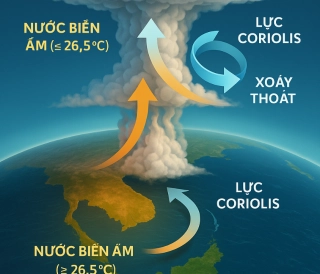
Bão nhiệt đới: hình thành, tác động và cách ứng phó
Bão là một hiện tượng thời tiết mạnh hình thành trên biển nóng. Khi không khí ẩm bốc lên cao, kết hợp với sự quay của Trái Đất (lực Coriolis), nó tạo ra luồng khí xoáy dữ dội. Bão mang theo gió lớn, mưa to, có thể gây lũ lụt, sạt lở và thiệt hại nghiêm trọng. Tuy nhiên, bão cũng giúp mang nước đến nơi khô hạn, làm sạch không khí và hỗ trợ tái sinh rừng
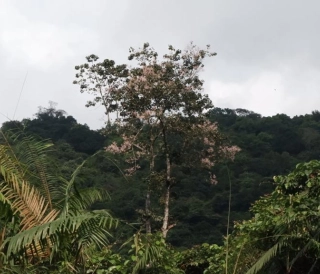
Phong Nha Botanical Garden – A “Living Museum” Within the World Heritage Site
Phong Nha Botanical Garden is a unique conservation site within the Phong Nha – Ke Bang World Heritage core zone. The garden preserves more than 500 plant species and 340 animal species; make it ideal for ecological research, education, and responsible tourism.